
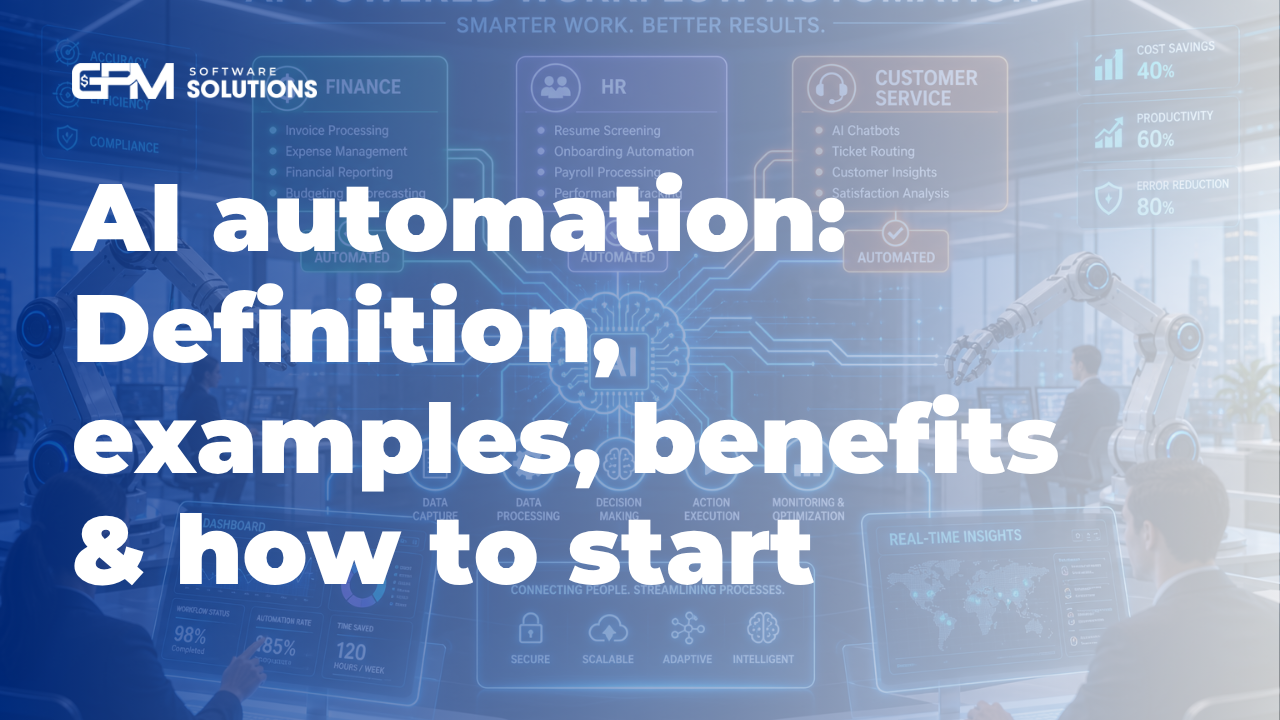
AI Automation: The Complete Guide for Business and Technology

AI automation is the use of artificial intelligence technologies to automate complex business processes, enabling machines to make decisions, learn from data, and perform tasks with minimal human intervention.
Summary: AI automation combines machine learning, natural language processing, and robotic process automation to streamline workflows, boost efficiency, and support digital transformation across industries.
What Is AI Automation? (Definition & Key Concepts)
AI automation refers to the integration of artificial intelligence (AI) into business and technology processes to perform tasks, make decisions, and adapt to new information—often without human input. Unlike traditional automation, which relies on static rules and scripts, AI automation leverages smart algorithms that can learn, reason, and improve over time.
Key differences from traditional automation:
Traditional automation: Follows predefined rules; best for repetitive, structured tasks.
AI automation: Uses machine learning (ML), natural language processing (NLP), and other AI technologies to handle unstructured data, adapt to changes, and make complex decisions.
Foundational concepts:
Machine learning (ML): Enables systems to learn from data and improve performance over time.
Natural language processing (NLP): Allows computers to understand and generate human language.
Robotic process automation (RPA): Automates rule-based tasks; when combined with AI, RPA handles more complex workflows.
Hyperautomation: The use of multiple automation tools, including AI, to rapidly automate business processes end-to-end.
Summary: AI automation goes beyond fixed rules by using learning and adaptation, making it ideal for dynamic business environments.
How Does AI Automation Work?
AI automation works by combining several core technologies to replicate—and often enhance—human decision-making in business processes. At its core, data is collected and analyzed by machine learning models, which then trigger automated actions based on learned patterns. NLP allows systems to interpret emails, chat messages, or documents, while RPA connects these AI capabilities to existing business systems.
Data Input: Collect structured and unstructured data (emails, forms, images).
AI Processing: Use ML and NLP to analyze, interpret, or predict outcomes.
Decision/Action: Automatically execute tasks, send notifications, or update records.
Feedback Loop: The system learns from new data and user feedback, continuously improving.
Summary: AI automation uses data-driven intelligence to automate tasks, learn, and adapt in real time.
AI Automation vs. AI Agents: What’s the Difference?
AI automation focuses on automating defined business processes, often behind the scenes. AI agents are autonomous programs that interact with users or systems, making decisions within a set context (e.g., a chatbot or virtual assistant).
Aspect | AI Automation | AI Agents |
Scope | Process/task automation | User/system interaction |
Visibility | Often invisible to end-users | Directly interacts with users |
Example | Invoice processing | Customer service chatbot |
Use AI automation for back-office efficiency; use AI agents where user-facing interaction or decision-making is needed.
Summary: AI automation streamlines processes, while AI agents interact and make contextual decisions for users.
Real-World Examples and Use Cases of AI Automation
AI automation is transforming industries by streamlining business workflows, increasing operational efficiency, and enhancing customer experience. Below are practical examples and detailed case studies:
Finance: AI automates fraud detection, loan approvals, and financial forecasting. For example, banks use AI bots to review loan applications in seconds, reducing manual work and errors.
HR: Automated resume screening and candidate outreach using AI-based platforms help organizations hire faster and more fairly.
Customer Service: AI-powered chatbots handle routine inquiries, freeing human agents to tackle complex issues.
Insurance: Intelligent claims processing and policy management are now possible.
Case Studies:
ERGO Insurance: Implemented AI-based bots to automate claims processing. The solution reduced claim handling time by 60%, improved accuracy, and allowed staff to focus on complex cases. ERGO also used NLP to extract information from claim documents, minimizing manual data entry.
The Hanover Insurance Group: Leveraged AI automation to enhance underwriting efficiency. Automated data extraction and risk evaluation improved decision speed and reduced human error, leading to a 30% faster policy issuance cycle and improved customer satisfaction.
123RF: A global stock photo marketplace, 123RF deployed AI automation for image tagging and copyright management. This allowed the company to process millions of images with high accuracy, cutting manual review time by over 50% and improving content discoverability for users.
BPC: In the banking sector, BPC used AI automation to streamline payment processing and compliance checks. The system flagged suspicious transactions in real time, ensuring regulatory compliance and reducing fraud losses by 40%.
Trek10: As an AWS partner, Trek10 automated cloud infrastructure management for clients using AI bots that monitored system health, scaled resources, and performed preventive maintenance. This led to a 75% reduction in downtime incidents and substantial operational savings for US-based clients.
Summary: AI automation delivers measurable gains in speed, accuracy, and cost across diverse business functions and industries.
Benefits and Challenges of AI Automation
AI automation offers significant business value, but also presents challenges that must be carefully managed.
Benefits | Challenges |
|
|
Key takeaway: Balance the efficiency gains of AI automation with careful planning for privacy, ethics, and integration challenges.
Summary: AI automation drives efficiency and savings, but requires attention to data, ethics, and change management.
How to Implement AI Automation: Step-by-Step Guide
Getting started with AI automation doesn’t have to be overwhelming. Here’s a practical roadmap for businesses:
Assess Readiness: Evaluate your current processes and digital maturity. Identify repetitive, high-volume tasks that impact business outcomes.
Set Objectives: Define clear goals—cost savings, efficiency, customer experience, or compliance improvements.
Choose the Right Tools: Research AI automation platforms (see comparison table below). Consider scalability, integration, pricing, and vendor support.
Develop a Pilot Project: Start small. Automate a single process to measure results and identify improvement areas.
Data Preparation: Ensure data quality, privacy, and compliance. Clean and structure data for AI models.
Implementation: Deploy the automation solution, integrating with existing systems (ERP, CRM, etc.).
Monitor and Optimize: Track performance metrics (time saved, accuracy, ROI). Use feedback to fine-tune models and processes.
Scale Up: Expand automation to additional processes based on pilot outcomes and lessons learned.
Tips for overcoming barriers:
Engage stakeholders early and provide training.
Adopt a phased approach to minimize disruption.
Partner with experienced vendors or AI automation agencies if needed.
Establish governance frameworks for data privacy and ethics.
Summary: Start small, focus on high-impact tasks, ensure data quality, and scale with clear governance for successful AI automation.
Comparing AI Automation Tools and Platforms
Choosing the right AI automation platform is essential for sustainable results. Below is a comparison of leading solutions used by US businesses:
Platform | Key Features | Pricing Model | Integration Options | Best For |
AWS | ML, NLP, scalable cloud services, RPA integration | Pay-as-you-go, tiered | API, AWS ecosystem, third-party apps | Enterprise-scale, cloud-first businesses |
Microsoft Copilot / Power Automate | AI assistants, workflow automation, Office 365 integration | Subscription | Microsoft 365, Dynamics 365, APIs | Productivity, knowledge work, SMBs |
Oracle | AI-driven analytics, process automation, cloud ERP | Subscription, enterprise | Oracle Cloud, APIs, legacy systems | Finance, large enterprise |
Amazon Q | Conversational AI, RPA, business process automation | Usage-based | Amazon ecosystem, APIs | Customer service, e-commerce |
Google (Gemini, Vertex AI) | Generative AI, ML, NLP, chatbot development | Pay-as-you-go | Google Cloud, APIs | Innovative AI, digital products |
Meta (Llama, AI Studio) | Open-source AI, NLP, social automation | Free/enterprise | APIs, social platforms | Social media, research |
Selection considerations: Evaluate scalability, ease of integration with your stack, support options, and long-term costs.
Summary: Select a platform that aligns with your tech environment, business needs, and future growth plans.
Industry Applications: Where AI Automation Delivers the Most Value
AI automation is delivering transformative results in US industries, particularly where complex workflows and large data volumes exist.
Finance & Banking: Accelerates loan processing, automates compliance checks, and enhances fraud detection.
Insurance: Streamlines claims management, risk assessment, and policy underwriting (see ERGO and The Hanover case studies).
Retail & E-commerce: Optimizes inventory management, personalizes product recommendations, and automates customer service (e.g., 123RF).
Manufacturing: Enables predictive maintenance, quality control, and supply chain optimization.
Healthcare: Automates patient scheduling, billing, and medical data analysis, improving care and reducing admin burdens.
Logistics: Enhances route optimization, shipment tracking, and real-time demand forecasting.
US companies like Trek10 and BPC have realized substantial operational efficiency gains, such as faster turnaround times and reduced costs, by integrating AI automation into core business workflows.
Summary: AI automation unlocks new efficiencies and customer value across finance, insurance, retail, healthcare, and beyond in the US market.
Monetization and Career Opportunities in AI Automation
AI automation is not just a technology trend—it's a lucrative business and career path.
Monetization:
Launch an AI automation agency to consult or implement solutions for other businesses.
Develop and sell AI automation apps or tools tailored to niche business needs.
Offer process automation as a service (e.g., managed RPA/AI bots).
Career Roles:
AI automation developer or engineer
Automation strategist or consultant
Process analyst with AI expertise
AI product manager
Skills Needed: Data analysis, machine learning, RPA, workflow design, cloud platforms, and business process mapping.
Courses & Certifications: Explore offerings from Microsoft, AWS, Google, and Coursera for AI automation courses and certifications.
Summary: Businesses and professionals can profit by developing, delivering, or managing AI automation solutions, with strong demand for skilled talent.
Future Trends and Outlook for AI Automation
The future of AI automation is defined by rapid innovation and deeper business integration.
Hyperautomation: Combining AI, RPA, and advanced analytics for end-to-end process automation.
Generative AI: AI that creates content, code, or designs, further expanding automation potential.
Industry shifts: More personalized customer experiences, autonomous operations, and data-driven management.
Workforce implications: Shift toward higher-value roles as routine tasks are automated; need for upskilling and governance.
Summary: AI automation will reshape industries, enabling smarter, faster, and more adaptable businesses.
Key Takeaways: Summary Table
Topic | Summary Point |
Definition | AI automation merges AI and automation to handle complex, dynamic business tasks. |
Benefits | Boosts efficiency, reduces costs, and enhances customer experience. |
Challenges | Requires careful planning for data, ethics, and integration. |
Implementation Steps | Start small, ensure data quality, scale gradually, and monitor results. |
Industries | Most impactful in finance, insurance, retail, healthcare, and logistics. |
Monetization & Careers | Opportunities in consulting, product development, and specialized roles. |
Future Trends | Hyperautomation and generative AI will drive the next wave of business transformation. |
Summary: AI automation is a powerful lever for business growth, efficiency, and innovation—when approached strategically.
Frequently Asked Questions About AI Automation
What is AI automation?
AI automation uses artificial intelligence technologies to automate business processes, allowing machines to learn, decide, and act with minimal human input.How does AI automation work in business?
It collects and analyzes data using machine learning and NLP, then automates workflows such as approvals, support, and data entry through integrated systems.What are some real-world examples of AI automation?
Examples include automated claims processing in insurance (ERGO), underwriting (Hanover), image tagging (123RF), payment compliance (BPC), and cloud management (Trek10).How can my business get started with AI automation?
Assess your readiness, define goals, choose a platform, run a pilot, ensure data quality, and scale up with proper governance and training.What are the main benefits and challenges of AI automation?
Benefits: efficiency, cost reduction, accuracy. Challenges: data privacy, integration, upfront investment, and change management.How do AI automation and AI agents differ?
AI automation manages processes behind the scenes; AI agents interact directly with users and make contextual decisions.Is AI automation a good career path?
Yes. Demand is high for AI automation developers, consultants, and strategists due to rapid adoption across industries.How can I make money with AI automation?
By offering consulting services, building custom automation solutions, or developing and selling AI automation tools and platforms.
Summary: AI automation offers huge potential for business transformation, monetization, and career growth when implemented thoughtfully.
Ready to unlock the power of AI automation? Explore GPM Login’s AI automation solutions, request a demo, or contact our team for tailored guidance.
AI workflow automation
Digital transformation strategies
Business process automation tools
Frequently Asked Questions
What is AI automation?
AI automation uses artificial intelligence technologies to automate business processes, allowing machines to learn, decide, and act with minimal human input.
How does AI automation work in business?
It collects and analyzes data using machine learning and NLP, then automates workflows such as approvals, support, and data entry through integrated systems.
What are some real-world examples of AI automation?
Examples include automated claims processing in insurance (ERGO), underwriting (Hanover), image tagging (123RF), payment compliance (BPC), and cloud management (Trek10).
How can my business get started with AI automation?
Assess your readiness, define goals, choose a platform, run a pilot, ensure data quality, and scale up with proper governance and training.
What are the main benefits and challenges of AI automation?
Benefits include efficiency, cost reduction, and accuracy. Challenges include data privacy, integration, upfront investment, and change management.
How do AI automation and AI agents differ?
AI automation manages processes behind the scenes; AI agents interact directly with users and make contextual decisions.
Is AI automation a good career path?
Yes. Demand is high for AI automation developers, consultants, and strategists due to rapid adoption across industries.
How can I make money with AI automation?
By offering consulting services, building custom automation solutions, or developing and selling AI automation tools and platforms.